Published
Compiled by We Agree More from published national survey research. Every figure on this page links to its primary source; the full bibliography is in the source library.
“The algorithm does not care what is true. It cares what is sticky.”
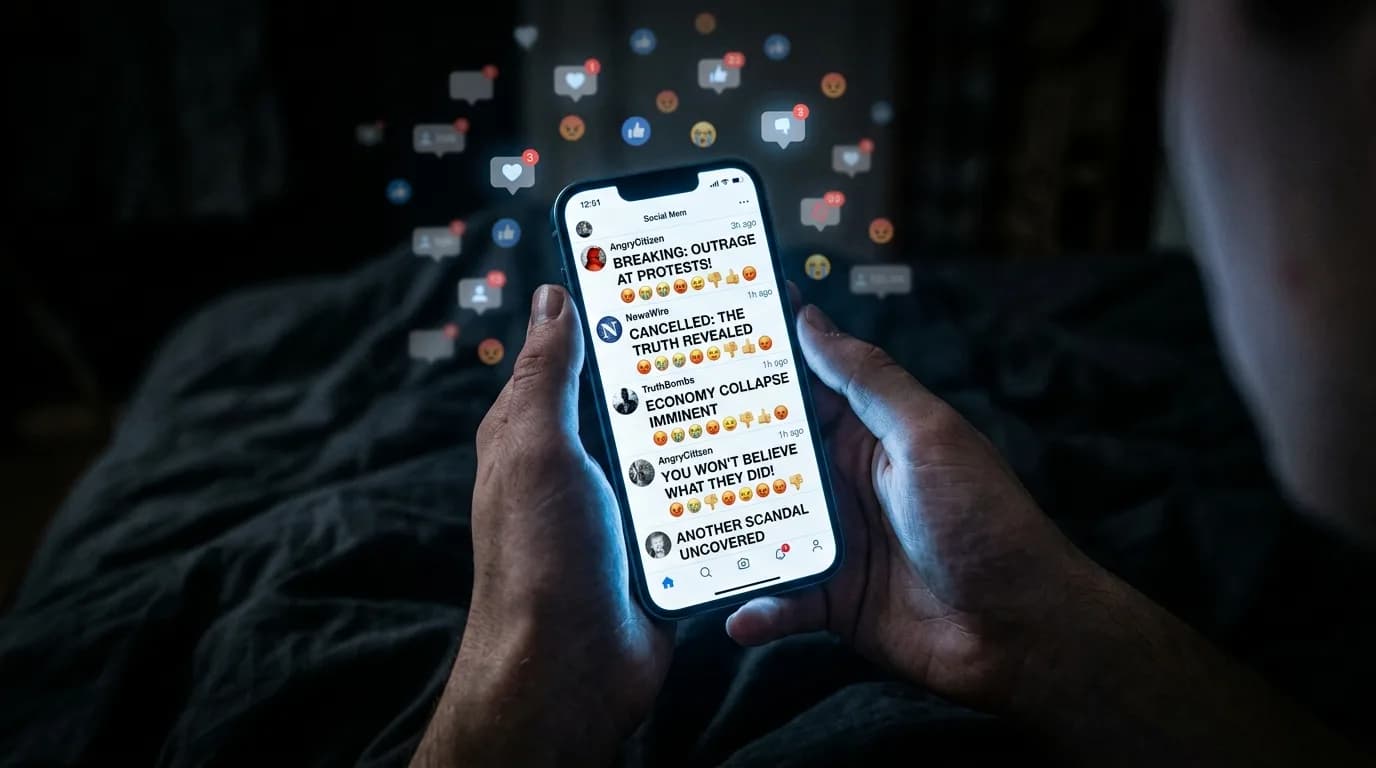
Social media platforms are engineered to maximize time on screen. Peer-reviewed research proves that emotionally provocative content — especially moral outrage — spreads faster, travels further, and holds attention longer than anything else.
In 2018, researchers at MIT analyzed 126,000 stories shared on Twitter and found that false news reached 1,500 people six times faster than truthful stories. Not because bots spread it — but because human beings are wired to share content that triggers surprise and disgust. The platforms know this. Their recommendation algorithms are tuned to surface the content that generates the strongest emotional reactions, because that content keeps users engaged — and engaged users see more advertisements. The result is a global information ecosystem where the most divisive, misleading, and fear-inducing content rises to the top of every feed, while measured, evidence-based, and unifying content is algorithmically buried. You are not using the platform. The platform is using you.
How It Works
Recommendation systems use reinforcement learning to model each user's engagement triggers. When outrage-inducing content produces longer view times and more shares, the algorithm learns to serve more of it. Each interaction trains the model to push the emotional boundary further. The user experiences a slow, invisible radicalization — not because anyone decided to radicalize them, but because radicalization is a side effect of engagement maximization.
What You Can Do About It
Turn off autoplay. Curate your feeds deliberately. Before sharing a post that makes you furious at fellow Americans, pause — that emotional reaction is exactly what the algorithm was engineered to produce.
By the Numbers
Combined annual advertising revenue of Meta, Google/YouTube, and TikTok — all driven by engagement optimization.
False news stories spread six times faster than true stories on social media, per MIT research published in Science.
of YouTube watch time is driven by the recommendation algorithm, not by user searches.
Share This